If you were born and raised in Hawai’i or spent a significant amount of time here, this list is the norm.
On Hawaiʻi Island, moʻolelo aren’t relics of the past — they are living currents that still move through the land and the people. Moʻolelo, often translated as “story,” is far more than folklore. It is knowledge passed from one generation to the next — through voice, chant, movement, and memory. Long before books or maps, moʻolelo carried genealogy, land boundaries, ocean wisdom, and spiritual understanding. Here on the island of Hawaiʻi, that tradition has never stopped breathing.
In places like Waipiʻo Valley, Puʻuhonua o Hōnaunau, and along the slopes of Mauna Kea, stories are inseparable from place. The land itself is an archive. The winds have names. The rains have personalities. The lava flows carry memory. Pele is not simply a character in myth — her moʻolelo teaches respect for volcanic power and the living nature of this island. To walk Hawaiʻi Island with awareness is to understand that every landscape holds narrative.
Hula and chant continue to preserve and perform these stories with intention. Each movement in hula kahiko encodes history, genealogy, and reverence for the natural world. Annual gatherings in Hilo, including the internationally recognized Merrie Monarch Festival, remind us that storytelling here is not static — it evolves while honoring its roots. Through kumu hula, immersion schools, and kupuna who still “talk story,” moʻolelo remain active, not archived.
In a time of rapid growth, development, and digital noise, living moʻolelo grounds Hawaiʻi Island in identity. They remind us that stewardship is not a trend — it is ancestral responsibility. For residents and visitors alike, listening becomes an act of respect. Because here, on Hawaiʻi Island, the stories are not just told. They are lived. 🌺
Never turn your back to the ocean... ever.
First major rule when it comes to Hawai’i’s waters…. never, EVER turn your back to the ocean. EVER. Always have someone watching your back if you absolutely need to face the
Warning signs are everywhere, pay attention.
This is literally the rule that a lot of people disregard and some, regret that they do. The warning signs are posted at every beach where there is a lifeguard present, yet people take the signs for granted. If you have questions, ask the lifeguard.
When the water looks calm or glassy, never assume that it is safe to swim. You never know what the conditions are beneath the surface- yes, the currents beneath the surface can be crazy!!
Never swim alone at an unfamiliar place.
If you’ve never been to the spot, always play it safe. Observe the conditions before you go out because, obviously, not all beaches are the same. Regardless of what you’ve seen on social media or what a friend tells you through the grapevine, do not swim alone. For millions of safety reasons, it is always better to go with someone or swim where there is a lifeguard posted.
If the shorebreak is crazy, DO NOT GO OUT.
For some people, the obvious isn’t so obvious. It would be wise NOT to go out, no matter what it looks like beyond the shore break. Just because it’s rough on the shore, doesn’t mean that it isn’t the same past the crashing waves and whitewash. In conditions like that, the currents and undertow will guarantee be nuts, as well. Don’t chance it!!!!!
On the reef or exploring the tidepools...
On days where the waves are crashing onto the reef, usually in the afternoon time, it can get pretty crazy. Mainly because the reef/tidepools is basically where the shore break is. See the video below:
This video was taken in slow motion at the Old A’s beach during a high surf advisory, on the tidepools. I thought it would be the perfect video to show just how powerful the whitewash can be. I was sitting about 20 feet away from the edge of the reef, where I thought the whitewash wouldn’t hit so hard. I was also wearing felt bottomed tabbies (or reef shoes) for safety. Still, at the 20 feet distance, the whitewash is still enough to push me with its disintegrated force. If I had been standing and not paying attention, I would’ve been knocked off my feet, dragged through the tidepools and severely injured.
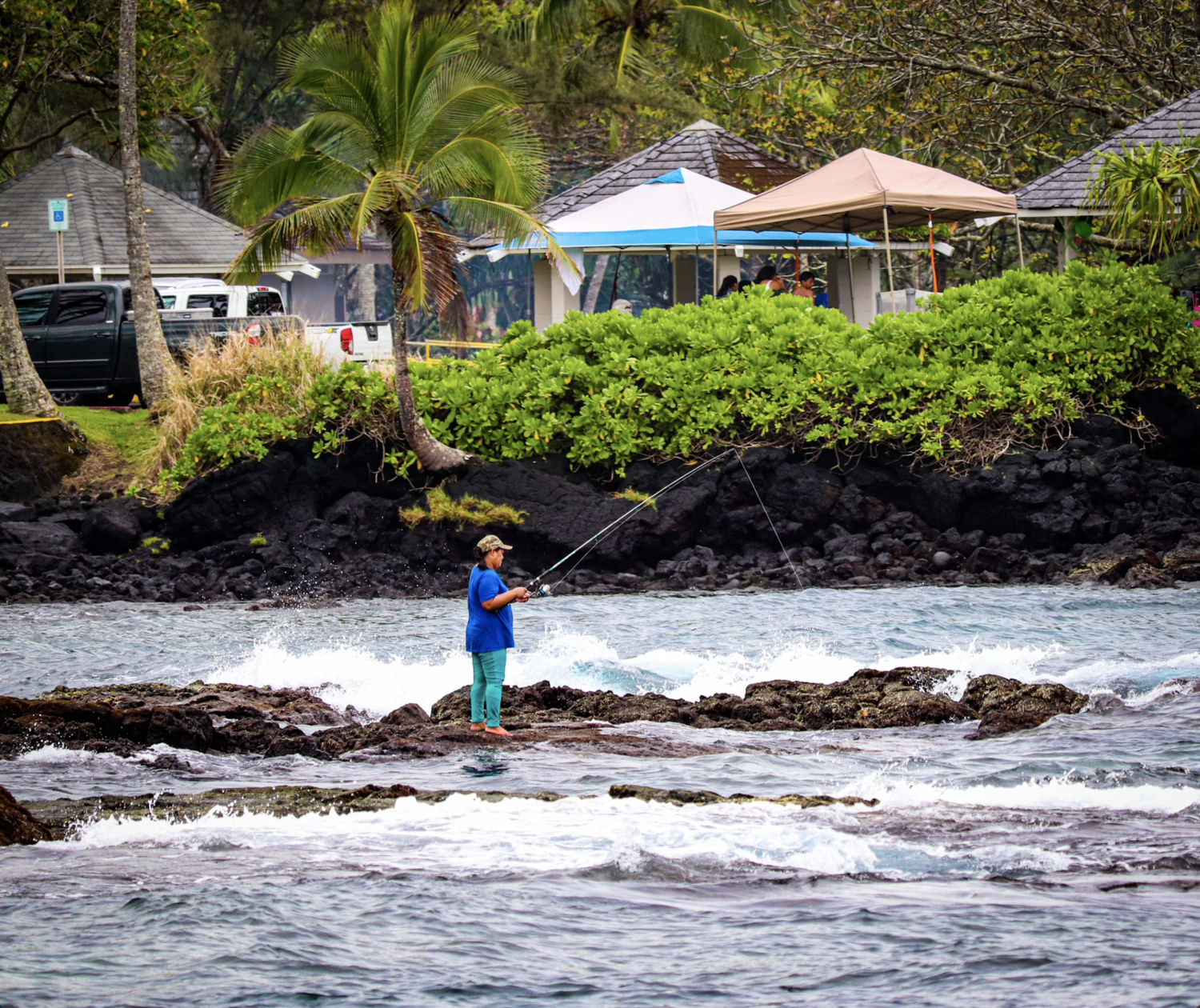
Fishing or collecting shells? Still need to pay attention.
I do both when I hit the beach. If the waves are crazy, I look for shells to add to my collection and ditch the pole- it’s common sense to me. Why try to cast a line out when the waves are probably going to drag it back in anyway? Right? Anyways, the rules of the ocean still apply to either activity- pay attention to the waves and the whitewash and never, NEVER face your back towards the ocean.
Wear felt-bottomed reef shoes/tabbies...
Slippers or tennis shoes are just not going to cut it on the reef/tidepools. Sure, it may look safe and dry to walk on, but as you get closer to where the whitewash comes in, it does and will get slippery. Common sense, seriously. I cannot even stress this enough. Get the reef shoes/tabbies and make sure they’re felt-bottomed- I promise you, you’ll thank me later.
Trying to get the perfect shot for the 'Gram? Don't.
Just don’t do it. Seriously. Sure, a shot with the waves pounding behind you might catch a lot of likes, but the consequences you’ll pay in the form of injuries are not worth it. Be safe, take selfies from a distance and, I don’t know, photoshop those waves (or yourself) in.
You're belongings? Keep them safe away from the shore or at home.
Or put it in a cooler, up to you. If you absolutely need to have your stuff, put it where the whitewash can’t reach it- on the driest rock there is and further away from edge or shore. The tide waits for no one to come in, recede and it will certainly not care what it takes with it. You won’t want to try and snatch your things as they are being whisked away, because you are going to get hurt.
Watch your kids, seriously.
Hawai'i's marine life... leave em alone!
If you haven’t seen the stories on the news or the videos circulating on social media, The Hawaiian Green Sea Turtle and the Hawaiian Monk Seal are on the Endangered Species List, amongst a few others native to Hawai’i. Do not get too close and let them be. Use the zoom feature on your camera or phone, there really is no need to get close. Visit the NOAA Endangered Species List for more information: Hawai’i NOAA.
While the beach is a place where we can all unwind, it is not the place to let your kids run wild while you enjoy a Truly on your towel. Besides the obvious reasons why you should be watching them, the ocean is truly an unpredictable beast. Pay attention and re-read the above rules, a million times if you must.
What's Next?
Learn how you can support cultural preservation on Hawaiʻi Island. Attend community events. Learn proper place names. Support Hawaiian-owned businesses. And most importantly — listen.
Check out our event calendar to get started now! Mahalo for your support.
The Heartbeat of the Big Island—Our mission is to keep our island community connected, informed, entertained, and supported. We are proud to serve the people of Hawaiʻi Island!